
Distance, Time, and Decisions: What a Defensive Pistol Encounter Actually Looks Like

Updated: Aug 19

Most people who carry a pistol have built their mental picture of the gunfight from movies, internet stories, and the occasional law enforcement statistic they half remember. The picture is usually wrong, and being wrong about it shapes how they train, what gear they choose, and what they expect their own performance to look like if the day ever comes.
A civilian defensive encounter is a compressed window of information, decision, and action, almost always happening at distances and speeds that nothing on a static square range prepares you for. If you carry, you owe it to yourself, your family, and anyone around you to be as capable as possible to handle these threats.
The defensive pistol curriculum at Achilles Heel Tactical is built and taught by David Acosta Jr., a seventeen-year law enforcement veteran whose career included two years of near-daily undercover narcotics work and four years on a U.S. Marshals Violent Fugitive Task Force. He has responded to multiple active shooter incidents. What follows is the reality he teaches against.

Distance
The number that gets thrown around most is the FBI's old three rounds, three yards, three seconds. It's been repeated so often it's become a mantra, and like most mantras, it's both true and misleading. Real civilian encounters happen close, but the distance is the opening distance, not necessarily where the shooting happens.
Most defensive problems initiate inside what we'd call conversational range. Three to seven yards. The robber stepping up at the gas pump. The carjacker at the driver's window. The aggressor inside a parking lot, restaurant, or convenience store. At those distances, the visual demand on you is low. The visual demand on the threat to find and hit you is also low.
Plenty of civilian incidents stretch out further than that. A gunman in an open public space might be 15, 20, or 25 yards away when you have to decide whether to engage. A rolling gun battle at a gas station can open up to 25 yards across the lot. On July 17, 2022, in Greenwood, Indiana, a 22-year-old armed citizen named Elisjsha Dicken engaged an active shooter in a mall food court from approximately 40 yards with a Glock he carried under Indiana's permitless carry law. He fired ten rounds, hit eight, and ended the attack 15 seconds after the first shot. He had no police training and no military background. While he engaged, he was motioning bystanders to safety behind him.
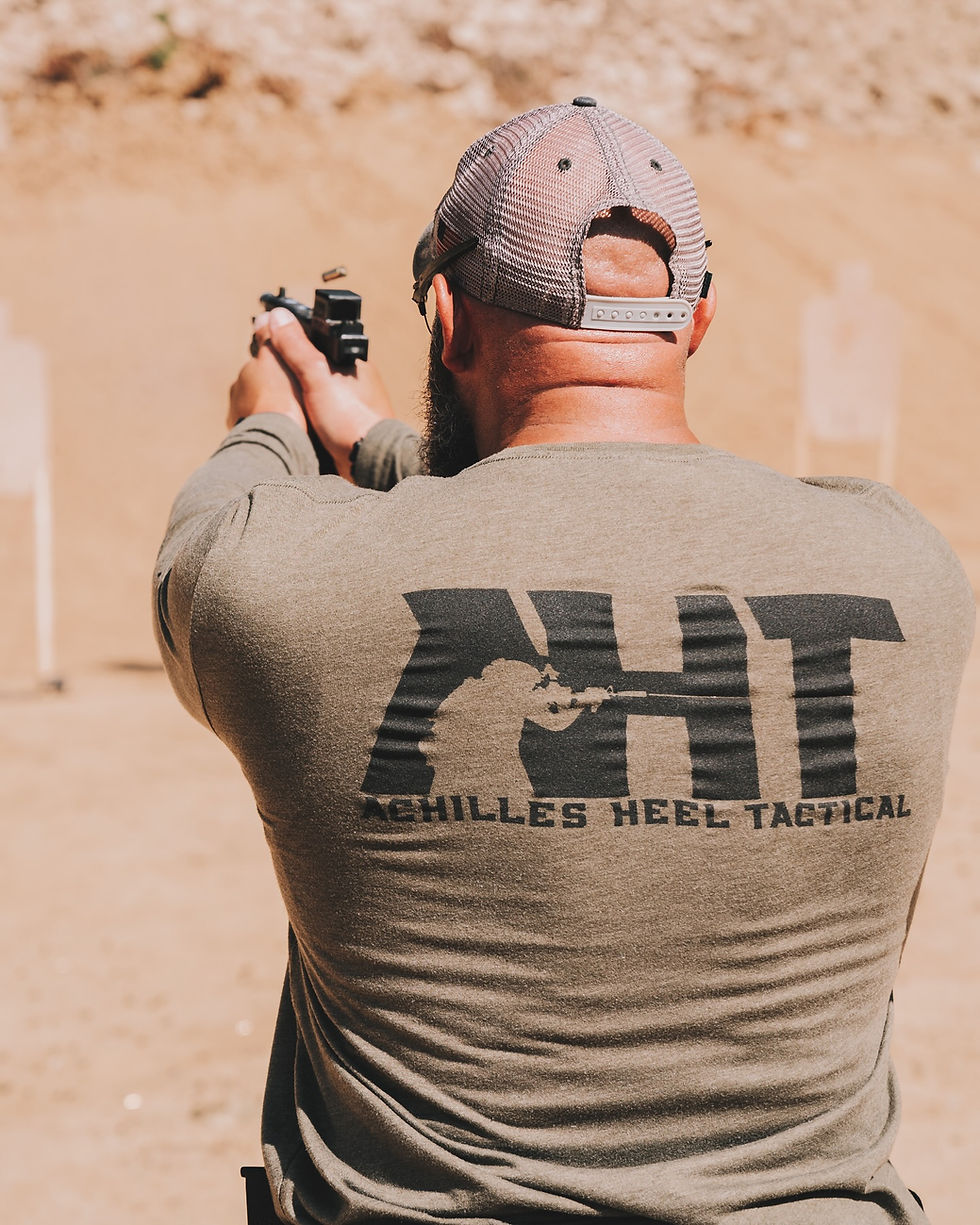
If your entire training regimen is mag dumps at five yards, the moment a problem presents itself at 20, you are improvising at a distance you've never honestly tested yourself at.
The takeaway isn't to spend all your training time at 25 yards. It's to know, by measurement, what your hits look like at every distance from contact to 25, and to recognize that the encounter chooses the distance, not you. Our DOPE drill exposes where the wheels fall off so to speak, so that you know what and where to improve.
Time
Time is what most shooters underestimate.
The threat moves on his timeline, not yours. By the time you recognize that what's happening is actually happening, an aggressor inside seven yards can close that distance in roughly a second and a half. A round leaves a barrel at about a thousand feet per second. The OODA cycle — observe, orient, decide, act — is not instantaneous, and the observe and orient stages are where most civilians lose the encounter. Not because they can't shoot, but because they refused to believe what they were seeing until it was too late.
Here's what that compression actually means on the timeline:
You don't get to set up. You don't get to assume a stance. You don't get to confirm your sights against a clean target. You will be drawing from concealment, possibly while moving, possibly while one hand is occupied with a phone, a child, groceries, or a steering wheel, against a target that is also moving, and you will be doing it with whatever skill you actually own, not the skill you wish you had.
A first shot from concealment to an upper-chest hit at seven yards, for a trained shooter, is somewhere between 1.2 and 1.8 seconds. For most concealed carriers who have never been on a timer, it's 2.5 to 4 seconds, if it lands at all. Whichever number is yours, that's the number that's available on the day.
Who Is The Threat
On a square range, the target is the target. It is paper, it is stationary, it is unambiguous, and it has done you the courtesy of standing still while you decide whether to shoot it. In the real world, the question of who is the threat is the most consequential decision you will make in the entire encounter, and it is the one you have the least time to make.
You have to identify, in the window of a second or two:
Is this person actually a threat, or is he reaching for a phone?
Is the man with the gun in the parking lot the attacker, or another armed citizen who got there first?
Is there a second aggressor? A third? Where are they?
Where is everyone who isn't a threat? Behind the threat? Behind you? In your line of fire?
What is your backstop? What is past your backstop?
On December 29, 2019, at the West Freeway Church of Christ in White Settlement, Texas, Jack Wilson, a 71-year-old firearms instructor and head of the church's volunteer security team, ended an active shooter incident with one round from roughly 15 yards. The total elapsed time from the attacker drawing a shotgun to Wilson firing was about six seconds. Two parishioners were killed in those six seconds. Wilson had to hold his shot because congregants were standing between him and the shooter. He took a head shot because it was the only clear shot he had.

The only way to build the mindset for processing those questions is to train in environments that force you to process them, against scenarios that include ambiguity, multiple roles, no-shoots, and consequences for the rounds that miss.
Every round you send has a name written on it. We've had students write Amy or Little Timmy next to a miss on a target to make it real. It is a useful exercise. It's also the reality of the legal and moral environment a civilian shooter is operating in.
The Decisions
Once distance, time, and identification have collapsed into the moment, what's left is decisions. Not one decision. A cascade of them, made in fractions of a second, with incomplete information.

Acosta teaches the use of force from three angles, in a specific order: moral, tactical, and legal. The moral piece comes first because a shooter who hasn't resolved, in advance, what they are and are not willing to do in defense of themselves or someone else won't be able to use the tactical skills they paid to acquire. The tactical piece is what most courses spend all their time on. The legal piece is what most courses skip entirely. All three have to be in place before the decisions below can be made well.
The first decision is whether to engage at all. The right answer is frequently no. Escape, cover, distance, or compliance may be the better solution, depending on the problem, and the willingness to make that call rather than default to the gun is the mark of a trained mind, not a timid one. The gun is one tool. It is not the answer to every problem just because it's the tool you brought.
The second decision is where to be. Standing still in the open where the threat first saw you is almost never the answer. Movement to cover, movement to angles, movement off the line the threat is working — any of these changes the math in your favor. Movement is also where most untrained shooters fall apart, because they've never fired a round with their feet doing anything other than standing still.
The third decision is when to shoot. Not whether the sights are perfect. Whether you have enough visual information, given the distance and the target size, to guarantee an accountable hit. At three yards, the visual standard is low. At twenty, it is not. Matching speed to demand is a learned skill.
The fourth decision is when to stop. The threat ends when the threat ends, not when the magazine ends. Continuing to fire on a target that is no longer a threat is a different problem with a different name, and it is one that follows shooters into courtrooms.
All of these decisions happen inside the same two-to-five-second window. None of them are made well by a shooter whose only repetitions are slow deliberate shots at static targets at an indoor range.
There's one more decision worth making before any of the above is ever on the table, and that's the one you make at home, on a normal day, while nothing is happening. If you carry, you need a plan for what comes after a defensive shooting, not just during one. Even a clean, justified shoot can put you in handcuffs, in front of a grand jury, and into six-figure legal bills before the investigation is closed.
Achilles Heel Tactical has teamed up with Attorneys On Retainer, a program run by The Attorneys For Freedom Law Firm, the only law firm in the country dedicated solely to self-defense cases. AOR is not traditional insurance. It's a retainer relationship with a team of criminal defense attorneys who answer a 24/7 line the moment something happens, who establish attorney-client privilege from day one, and who cover circumstances most insurance-backed plans specifically exclude. If you carry a pistol for protection and you don't have a plan for the legal aftermath, you have built half of a strategy. Fix that before you need it.
As part of that collaboration, AHT students and readers get $50 off their individual plan sign-up fee or $25 off sign-up fees per person when starting a family plan. The link below imports the code automatically when you reach that step in the sign-up flow.
To learn more about AOR or get started, go to: https://attorneysonretainer.us/creators/achilles-heel-tactical/
AOR Disclaimer: AOR is backed by Attorneys For Freedom, an independent AZ law firm exclusively representing clients in self-defense cases, offering representation in all 50 states and DC in collaboration with local co-counsel. www.AttorneysForFreedom.com
FTC Disclaimer: We are an affiliate of AOR engaged in marketing and receive compensation when someone joins AOR using this promo code.
What This Means For Training
Understanding the mechanics of a defensive encounter makes defensive pistol training mandatory if you carry daily. The distances dictate where you should be honest about your hits. The time pressure dictates the speed at which you need to draw from the holster. The identification problem dictates that your training environment should include more than just paper. The decision cascade dictates that you've made versions of those decisions before, under stress, with feedback, so the day they matter isn't the first day you've made them.
The gap between owning a pistol and being able to use one is a preparation problem, and it's solvable.
If you've been practicing at your local range and assuming the rest will come naturally on the day, it won't. You don't rise to the occasion. You fall to the level of your training, and the level of your training is whatever you've actually practiced against realistic parameters.
The work we put into our defensive pistol training is built around those parameters from the first drill to the last. Distance accuracy tested. First round hits measured. Identification and decision-making tested. You leave knowing what you can do, what you can't do yet, and what to put your reps into next.
Take a look at our training schedule or browse the full course catalog. Bring what you carry. We'll show you what it can actually do in your hands.
Continue Reading
The defensive pistol class is the foundation. From there, the curriculum builds outward into the environments where civilian violence actually happens. Two related pieces by the same instructor:
Civilian Response to Active Shooter Training — how the principles in this article extend to active threat events at gas stations, grocery stores, and public spaces, and what the 2-Day Active Shooter Response course teaches against the singleton problem most civilians will actually face.
Mastering Home Defense Firearms Training — what changes when the fight happens inside your own walls, in low light, half-awake, with family in the house.
Comments